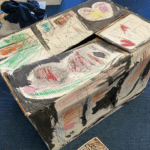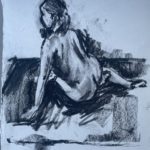
This page summarises the extraordinary wealth of opportunities that 2D2 dimensions Two dimensional space is on the same plane, and is essentially flat, having two characteristics, length and width. Sometimes written or said as ‘2-D’, it refers to art works that have a height and width but no obvious thickness or depth, such as paintings, drawings and prints. (two-dimensional/dimensions) processes and techniquesA procedure, formula or routine by which an outcome or artwork is achieved, to include weaving thread into cloth with a darning needle, carving wood with a chisel and throwing clay on a wheel to make a pot in artArt refers to a diverse range of human intellectual and expressive activities and the outcomes of those activities. Within this context art is further defined as visual art and includes painting, drawing, sculpture, printmaking, photography and work made using digital media., craftCraft can be designed as intelligent making. It is technically, materially and culturally informed. Craft is the designing and hand making of individual objects and artefacts, encouraging the development of intellectual, creative and practical skills, visual sensitivity and a working knowledge of tools, materials and systems. More about craft can be found here and designDesign shapes ideas to become practical solutions and propositions for customers and users. Design is all around us, everything man made has been designed. The majority of designers work in teams, following a design brief and a process towards realising a commercially driven product, building, system or service can provide for children and young people.
These processes and techniques have been organised into six distinct approaches that provide popular creativeBeing creative or 'creativity' relates to or involves the use of the imagination or original ideas to create something. pathways when working largely on a flat surface.
2D provides an excellent place for the exploration of the formal elementsThe Formal Elements are the parts used to make a piece of artwork. The art elements are line, shape, space, form, tone, texture, pattern, colour and composition. They are often used together, and how they are organised in a piece of art determines what the finished piece will look like. The principles of art are scale, proportion, unity, variety, rhythm, mass, shape, space, balance, volume, perspective, and depth.: LineLines are used by artists and designers to describe objects, add detail or create expression. Lines define an artwork and reveal the artist’s techniques. Line is one of the visual elements. It is the path of a moving point, such as a pen, pencil or brush. In your work, it is important to vary the quality of lines, making them bold and heavy or light and delicate to suggest different things. Line can be used to give the impression of different textures and tones as well as simply showing where the edge of an object meets space - remember that objects do not have outlines in real life., shapeShapes are two-dimensional. Positive shapes represent solid objects and negative shapes show the surrounding space. Geometric shapes are perfect and regular. Organic shapes are irregular and natural., space, colourChoices of colour and the relationships between colours have a huge influence on how a piece or art or design looks and feels and the emotions it provokes. Colour is made up of different aspects. The most useful terms used to describe these aspects are probably: hue, tone, saturation, complementary, analogous, tint, shade, primary and secondary., formForm refers to three dimensional objects. While shapes have two dimensions (height and width), forms have three dimensions (height, width and depth). The overall unity of the visual elements in an art work; it is usually contrasted with content. Form is sometimes used to refer to the three dimensional aspect of an art work, as opposed to shape, which is seen as referring to two dimensional aspects., toneThe relative lightness or darkness of a colour. E.g. Light, dark, tint, shade, black, white, grey, shadow, highlight, contrast, monotone, high key, low key. Tone is normally seen as one aspect of colour, concerned with its lightness or darkness; in painting, if different amounts black and white are added to a hue, the results are different tones., textureArtists and designers can use actual texture in their work or they can suggest how something feels using techniques that imply texture. There are two types of texture: actual texture and visual texture. E.g. Rough, smooth, hard, soft, matt, shiny, waxy, coarse, glossy, scratchy, silky, wet, dry, feathery. Texture is the surface quality of an object. In art, it can refer to an illusion of texture, for example in a painting that shows the smoothness of a child’s face and the rough surface of a tree. It can also refer to actual texture, as in a collage. In your own work, you can achieve different textures by adding different materials to your paint, or by incorporating things such as fragments of hard clay, sawdust or sand into the medium you are using., patternA design in which lines, shapes, forms or colours are repeated. E.g. Regular, irregular, repeat, tessellating, symmetrical, natural, geometric, rotation, grid, rhythm, decorative, border. Pattern has three main meanings: 1) a decorative design, usually of a repeated motif or figure; 2) the composition or layout of an artwork; 3) the model or mould used for casting. In the first kind of definition, visual forms, or motifs are repeated, often in a systematic manner, such as in the repeated geometric forms found in Islamic art. and compositionThe combination of a selection of distinct elements to work towards creating a whole image or form. The arrangement of shapes, colours, textures, marks and lines in a painting. A composition is something that is put together - it is an arrangement of different elements. In art, the visual elements are combined by paying attention to things such as balance, harmony, rhythm and contrast to give a unified whole. Sometimes composition is used to refer to one piece of art work, such as a painting. It is a place where images can be realised through numerous methods.
Working in 2D provides opportunities that are hugely varied whilst also being one of the most accessible formats, which, at their most basic level, require little more than a sheet of paper and a medium to apply to it.
A challenge would be, however, to ensure that when working in 2D there continues to be innovationInnovation is a process by which a domain, a product, or a service is renewed and brought up to date by applying new processes, introducing new techniques, or establishing successful ideas to create new value. The creation of value is a defining characteristic of innovation., ideation (the activity of forming ideas in the mind) and discovery… not simply a default medium of practical convenience.
Equally, young artistsPeople who are engaged in a broad spectrum of visually led ideas and activities aligned to the expressive arts need to appreciate the relationship between 2D and 3D3 dimensions Three dimensional space is in the 'round', and has a combination of three characteristics from the following five terms; length, width, height, depth and breadth. We live in a three-dimensional world. Sometimes written or said as ‘3-D’, it refers to art works that are solid, having height, width and depth, such as models and sculptures. (three-dimensional) and activities that balance these two approaches often prove to be doubly rich and rewarding.
The following processes and techniques will inspire young artists, makers and designersPeople who are engaged in the production of functional products, services and systems to explore diverse 2D processes and techniques that enable them to become confident and effective creative practitioners.