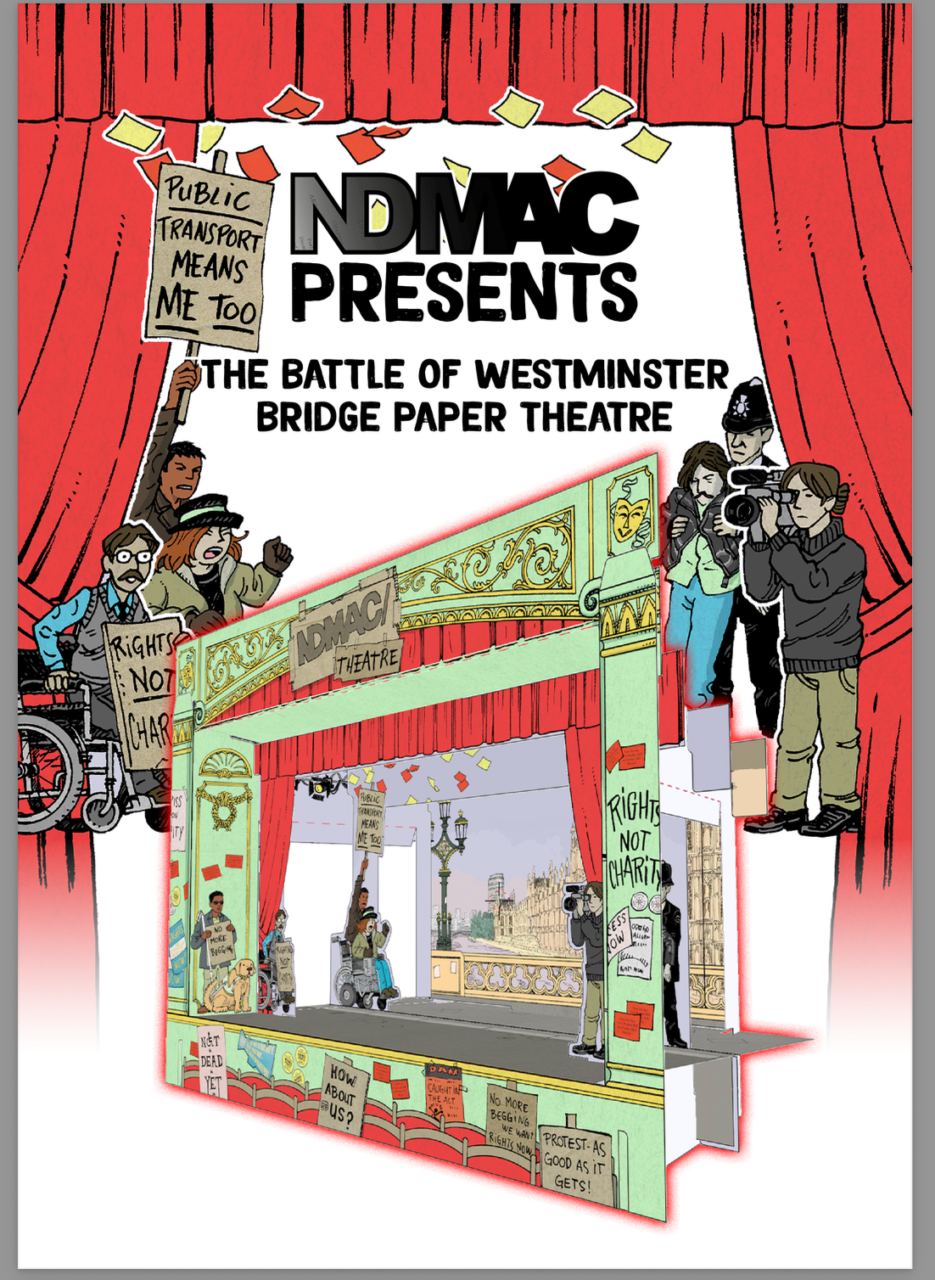
National Disability Movement Archive and Collection (NDMAC) is funded by the National Lottery Heritage Fund, supporting educational engagement with a new project telling personal stories from the UK disability rights movement. As its centrepiece, we have created a unique and fun paper theatre about disabled people and rights which we are distributing FREE in both digital and print copies: see attached flyer and paper theatre sample.
Our starting point was considering ways in which to tell a little-known story of rights and protest that has had a gigantic impact on millions of lives. We want this story to reach the generation currently in secondary, higher and further education who may not be familiar with the Disability Discrimination Act 1995 (DDA) and its significance in UK social history, and for whom disability rights have not been fought for so visibly, spectacularly, and consequentially, during their lifetime.
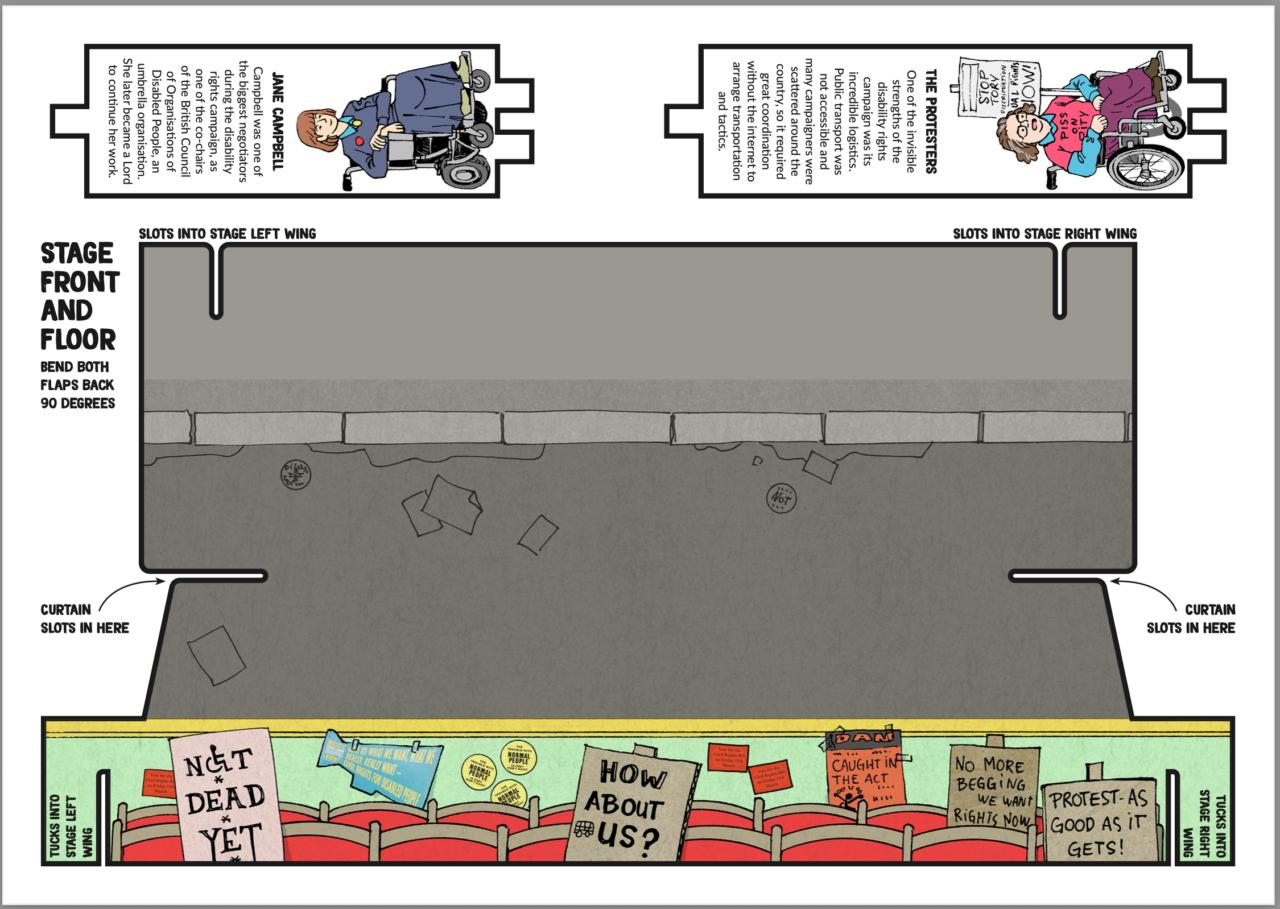
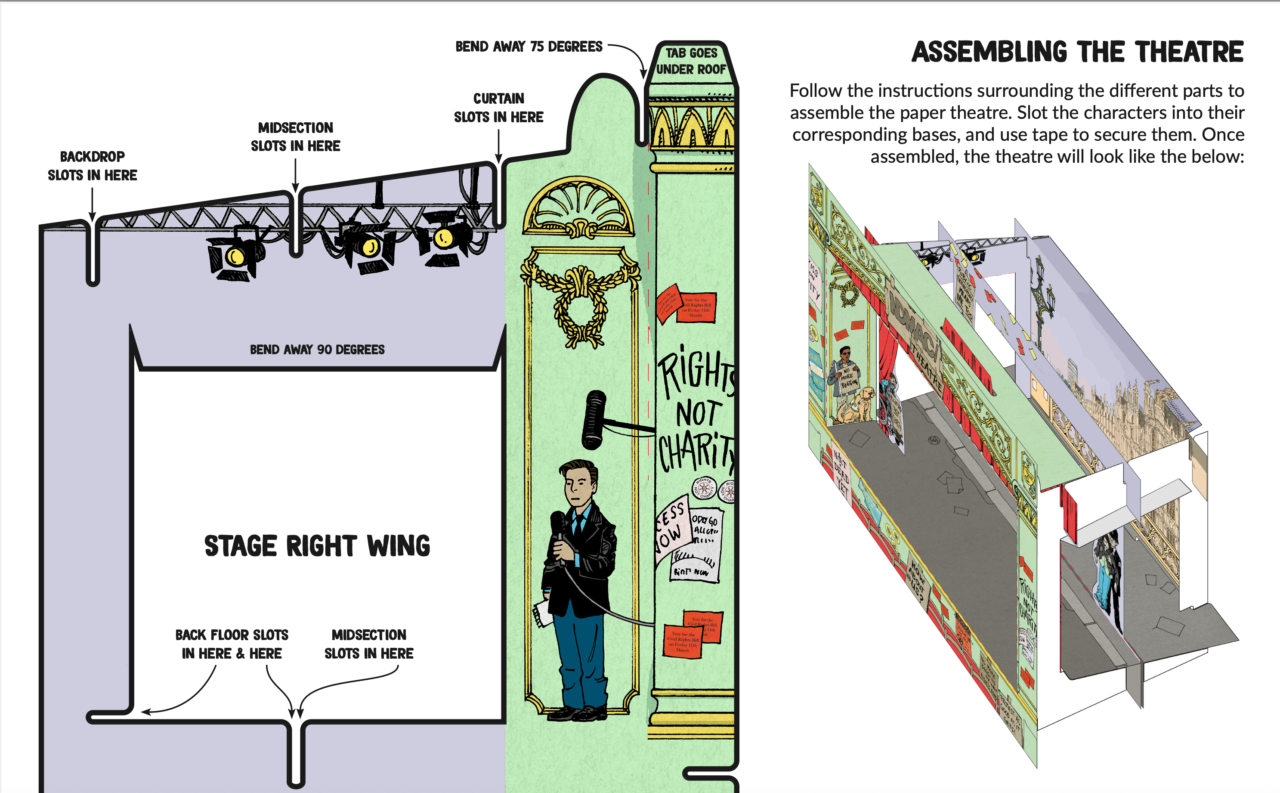
To this end, among a range of creative tools, we devised our Paper Theatre, titled The Battle of Westminster Bridge. It is designed as a fun and engaging learning tool, in which pupils and students can recreate the iconic protests against inaccessible public transport held on Westminster Bridge by the Disability Rights Movement in the 1990s, which helped achieve civil rights for disabled people. The paper theatre is a way of learning both UK history and some empowering disability stories and could be a starting point for a theatre design and disability focus.
In considering the medium of the theatre stage, our decision to use a low-fi paper-and-scissors approach to activism was partly in response to a resurgent interest in analogue craft-based practices we find today, whether though zine cultureThe behaviours, beliefs and activities of a social, geographical, age defined or ethnic group of people, to include their artistic and creative pursuits or, for example, among disabled people in digital poverty. Although the Paper Theatre contains information and steers the participant in a direction based on an existing narrative, it is designed to be jumping-off point for further research, investigation, designDesign shapes ideas to become practical solutions and propositions for customers and users. Design is all around us, everything man made has been designed. The majority of designers work in teams, following a design brief and a process towards realising a commercially driven product, building, system or service and discussion and to encourage users to visit ndmac.org.
There are learning opportunities linked to artArt refers to a diverse range of human intellectual and expressive activities and the outcomes of those activities. Within this context art is further defined as visual art and includes painting, drawing, sculpture, printmaking, photography and work made using digital media., design and makingThe process of making or producing something. The making of meaning is a decisively integral component of art-making. Meaning-making in relation to the creation of art serves a symbolic and practical purpose. On a symbolic level, the essence of meaning-making is highlighted when we encounter works of art that are of an abstract nature., as well as social history and sociology, and anywhere that students can reflect on how ideas about our ‘rights’ can be transformed into actionable law that influences how we behave and treat others.
To support this, we created a robust design that, while minimal in formForm refers to three dimensional objects. While shapes have two dimensions (height and width), forms have three dimensions (height, width and depth). The overall unity of the visual elements in an art work; it is usually contrasted with content. Form is sometimes used to refer to the three dimensional aspect of an art work, as opposed to shape, which is seen as referring to two dimensional aspects., contains complex ideas and dynamics to be understood and ‘unpacked’ in a variety of ways. It is accessible to students of different learning styles and backgrounds, and designed to stimulate engagement with those for whom ‘disability’ might seem an off-putting or irrelevant term, imbued as it is with generational stigma.
The good news is that by utilising our resource you will be helping NDMAC to achieve our aims and being part of the change.
We invite educators and students alike to utilise this resource in any setting where ideas about rights, social change and identity are being tackled and discussed, and very much welcome you to contact us with snippets and stories about how the Paper Theatre made things work and the conversations and creativityCreativity is a characteristic of someone or some process that forms something new and valuable. The created item may be intangible or a physical object. Scholarly interest in creativity is found in a number of disciplines, primarily psychology, business studies, and cognitive science. Creativity is a tendency to generate, make or recognise ideas, propositions and possibilities that bring into existence something new, innovative or different. Imaginative activity fashioned so as to produce outcomes that are both original and of value. Creativity is the ability to create items that inspire and inform others, often in aesthetically pleasing ways. Creativity is thinking outside of society's norm. It is being able to express oneself in different varieties of arts - painting, poetry, sculpture, style, fashion, etc. to flow.
Digital downloads are available on Etsy and itch – go to this link. The only fee being 50p to cover Etsy costs. The paper theatre will also join the ndmac.org website in summer 2026.
Free print copies:
We can supply professionally printed, die-cut copies of the paper theatre with - for FREE. Order by emailing liam@shapearts.org.uk with the subject lineLines are used by artists and designers to describe objects, add detail or create expression. Lines define an artwork and reveal the artist’s techniques. Line is one of the visual elements. It is the path of a moving point, such as a pen, pencil or brush. In your work, it is important to vary the quality of lines, making them bold and heavy or light and delicate to suggest different things. Line can be used to give the impression of different textures and tones as well as simply showing where the edge of an object meets space - remember that objects do not have outlines in real life.: NDMAC Paper Theatre Print Version requesting as many free copies as you wish – up to 50 per organisation and up to 15 per individual – and for which you can charge as you see fit (to cover/recover your costs). You would also be welcome to use the digital version online, again FREE.
For more information visit ndmac.org