Structuring learning through Design within Art & Design
Can we improve our structuring of CreativeBeing creative or 'creativity' relates to or involves the use of the imagination or original ideas to create something. Learning to better develop a breadth of learning?
ArtArt refers to a diverse range of human intellectual and expressive activities and the outcomes of those activities. Within this context art is further defined..., CraftCraft can be designed as intelligent making. It is technically, materially and culturally informed. Craft is the designing and hand making of individual objects and... and DesignDesign shapes ideas to become practical solutions and propositions for customers and users. Design is all around us, everything man made has been designed. The..., creative visual practice and all forms of designing for makingThe process of making or producing something. The making of meaning is a decisively integral component of art-making. Meaning-making in relation to the creation of..., presenting and visual representation all operate by a set of ‘creative rules’ or shared fundamental principles. These have been arrived at over time and across cultures to set a standard, a language of visual grammar and to help us share an understanding of how we think, create and what we wish to communicate visually.
The Artistic (or Formal) Elements formForm refers to three dimensional objects. While shapes have two dimensions (height and width), forms have three dimensions (height, width and depth). The overall unity... the basis of how we teach basic skillsTechniques and attributes acquired through learning, engagement and practice, build technical and creative knowledgeFacts, information, and skills acquired through experience or education; the theoretical or practical understanding of a subject., alongside building an understanding of visual literacyVisual literacy is the ability to interpret, negotiate, and make meaning from information presented in the form of an image, extending the meaning of literacy,... and visual communications. These seven elements are elemental in so much as they are the building blocks of lineLines are used by artists and designers to describe objects, add detail or create expression. Lines define an artwork and reveal the artist’s techniques. Line..., shapeShapes are two-dimensional. Positive shapes represent solid objects and negative shapes show the surrounding space. Geometric shapes are perfect and regular. Organic shapes are irregular..., toneThe relative lightness or darkness of a colour. E.g. Light, dark, tint, shade, black, white, grey, shadow, highlight, contrast, monotone, high key, low key. Tone..., form and colourChoices of colour and the relationships between colours have a huge influence on how a piece or art or design looks and feels and the... etc. But they don’t offer a complete set of elements, for example, we also need to consider ‘mark’, ‘expression’ and other principles of design and visual grammar. Hence, these elements are a list, they don’t define the totality of how we draw a line, how we make it descriptive or expressive. Similarly, they don’t explain what value of tone means and how you might use tonal value to create a representation of light and tone, or the way surfaces can be defined and appear by the way light strikes a form.
Achieving a deeper knowledge and understanding of visual literacy and visual grammar, requires context and teaching through a structured sequence of learning and a well-defined curriculumIn education, a curriculum (or curricula) is broadly defined as the totality of student experiences that occur in the educational process. The term often refers specifically to a planned.... There are many published examples from the English National Curriculum, or see:A Practical Guide to Teaching Art and Design in the Secondary School. Edited by A Ash and P Carr. Routledge (2024). Equally, we can also reference examples from education history, such as Bauhaus examples from the Preliminary Courses by Johannes Itten, László Moholy-Nagy or Josef Albers. Further evidence can be seen in Paul Klee’s Pedagogical SketchbookA vehicle for exploring and containing visual or written prompts ideas and sketches, a means of information gathering, traditionally in a specific book with blank... which explore mark and the expressive qualities of line, or the minutes of his Bauhaus classes on shifting, rotating and mirroring, documented by Lena Bergner (see the Links below). The evidence from this periodA specific historic time and context of an art, craft or design form adds up to a Manifesto for Visual Learning, certainly worthy of consideration.
'In the epistemic context of a fundamental skepticism towards the existing knowledge system, the Bauhaus school was in pursuit of “unlearning”: dismissing conventional learning and promoting pre- linguistic, intuitive approaches- which also led to adoptions of non-academic modes of perceptionVisual perception, which is the ability of the artist to recognize and understand visual phenomena and aesthetic clues, is fundamental in creating and responding to works... and included an interest in pre-modern knowledge systemsA set of interacting or interdependent components forming an integrated whole.' Regina Bittner
Bittner confirms the importance of unlearning from ‘existing knowledge systems’ in order to build new epistemological models of creating and design thinking. This is the processA series of actions, changes or operations performed in the making or creating of a product or outcomes. The procedures that one goes through in... of innovationInnovation is a process by which a domain, a product, or a service is renewed and brought up to date by applying new processes, introducing... in creative subjects and is continuous. This was how design as we know it now, was created and it is evolving again around Design and to embrace AI.
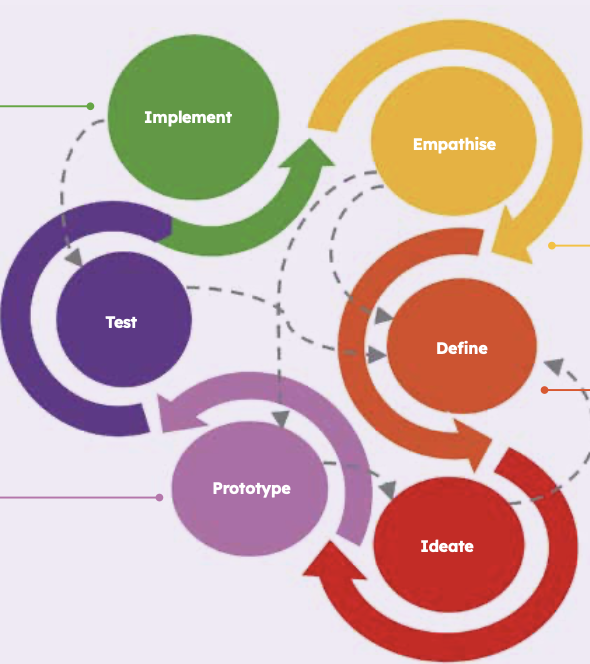
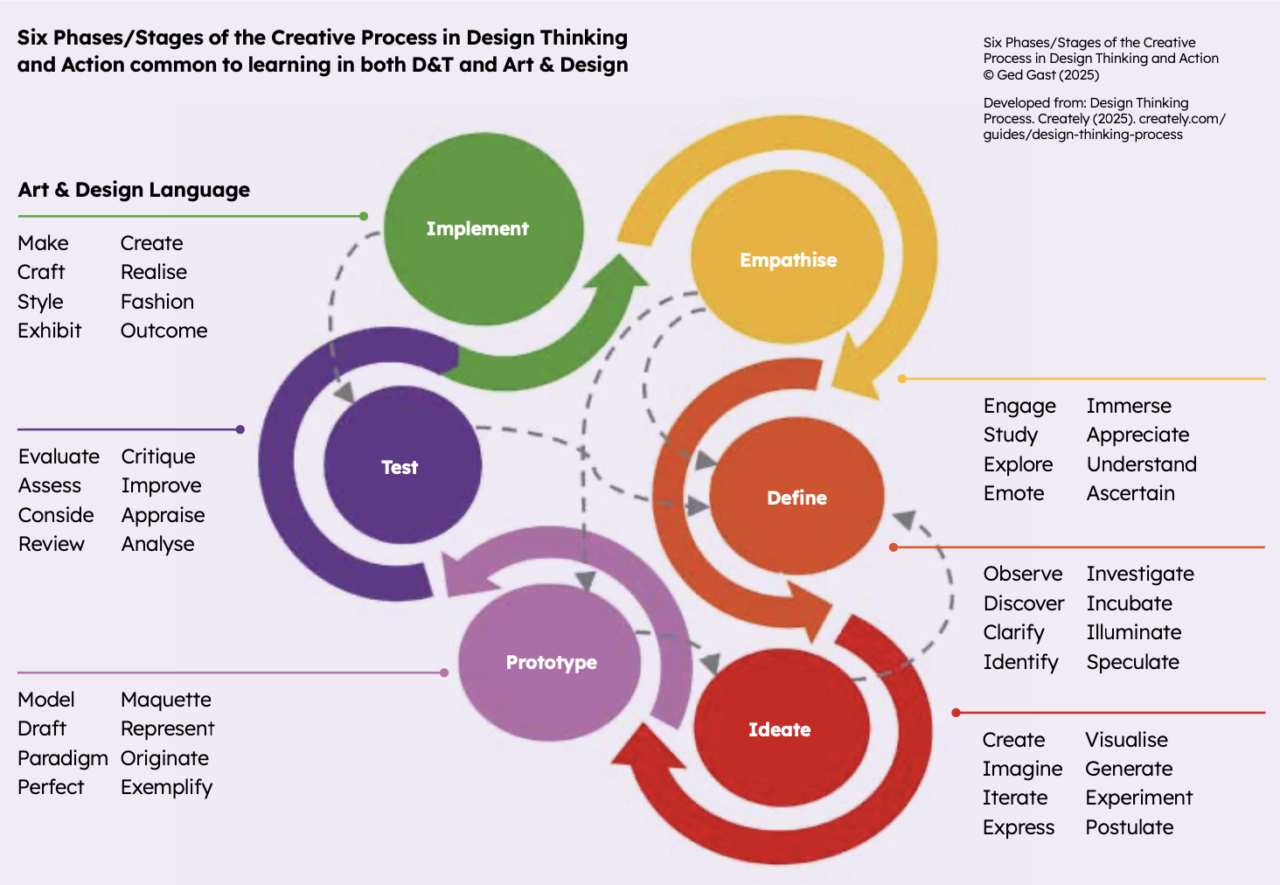
To support our understanding of ‘design’ and design processes (phases or stages) when teaching, you might find it helpful to use this graphic which adds typical art and design language to design processThe design process is a way of figuring out what you need to do, and then doing it. Along the way you might solve one or... stages, common to both art and design and D&T. The use of dotted arrows linking stages, typify the non-linear flexibility and complexity of thinking in art and design. By making our emphasis on design more explicit in our art and design teaching, we can increase understanding, explore the tension between the twin aspects of our disciplineA specific way, a set of procedures and techniques for a specific activity e.g. the discipline of drawing embraces perspective, figure and conceptual ways of..., widen the scope of contextual references and boost career focused thinking about the creative industriesA range of economic activities concerned with the generation or exploitation of creative knowledge and information. The creative industries include advertising, architecture, radio and TV,....
This diagram was published in AD 45, The Design in Art and Design issue, Jan 2026. See links below
How does the Bauhaus help us understand the evolution of both Art and Design?
The Bauhaus teachers thought carefully about how to teach the artistic elements, how to make them expressive and communicate meanings. They also considered issues such as tactility and the haptic, as a means of knowledge generation to develop understanding of the sensual properties of materialsThe resources that artists, craftspeople and designers use to create work, to include thread, plastic, stone, wood, clay, paint and paper. They developed our modern-day understanding of art and design as a process of investigation rather than knowing, promoting a transformation of human modes of perception and leading to contemporary concepts of modernismMuch of the art of the first half of the 20th century can be called ‘Modern’. It is characterised by a concern for new ways....
However, these Artistic Elements get you only so far. They require further principles and concepts to help us design, to be creative and control the arrangement of elements to make more complex images, design new paintings, products and communicate complex meanings. For this, we need ways to build student’s understanding of aestheticsA term used to explore and explain the look and sensual appeal of a work of art, craft or design. The term embraces aspects of... and through this, manipulate and implement control. These include, the Principles of Design and the ability to manipulate the ‘grammar’ of visual expression, including an understanding of compositional rules, design and stylistic conventions.
'Knowledge is power. I condemn this sentence as the most dangerous pedagogical false doctrine, even if many do not want to understand it that way. What is ‘knowledge’? Not being able nor knowing, not seeing nor looking, neither building nor forming. It is possession of so-called facts, which one can buy dearly in schools and books, collect and accumulate, in order to reproduce them first in the examination and afterwards, perhaps, also (re-evaluate) in order to understand something better.[…] Instead of “knowledge is power,” I recommend for education important tasks of our time.' Josef Albers