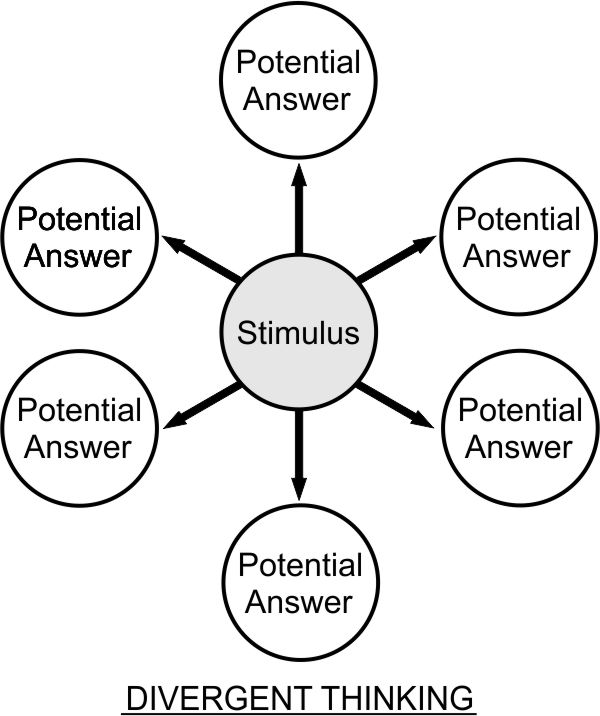

Divergent thinking is a thought processA series of actions, changes or operations performed in the making or creating of a product or outcomes. The procedures that one goes through in creating an art-work, e.g.: the process of printmaking. or method used to generate creative ideas by exploring many possible solutions. It typically occurs in a spontaneous, free-flowing, "non-linear" manner, such that many ideas are generated in an emergent cognitive fashion. Many possible solutions are explored in a short amount of time, and unexpected connections are drawn. Following divergent thinking, ideas and information are organized and structured using convergent thinking, which follows a particular set of logical steps to arrive at one solution, which in some cases is a "correct" solution.
The psychologist J.P. Guilford first coined the terms convergentConvergent thinking is an ideation mode which designers use to analyze, filter, evaluate, clarify and modify ideas they have generated in divergent thinking. They use analytical, vertical and linear thinking to find novel and useful ideas, understand the design space possibilities and get closer to potential solutions. The term was coined by Joy Paul Guilford as the opposite of divergent thinking. It generally means the ability to give the "correct" answer to standard questions that do not require significant creativity, for instance in most tasks in school and on standardized multiple-choice tests for intelligence. thinking and divergent thinking in 1956.